How Your Skincare Compatibility Score Works
You scan a moisturizer, and a single number pops up next to it. That number is your skincare compatibility score, and it exists to answer one question: is this product a good fit for your skin, not for some average face in a lab. Understanding your skincare compatibility score means knowing which inputs feed it, how ingredient risks get weighed against your goals, and what a high, medium, or low result should actually change about your next purchase. Instead of asking you to memorize chemistry or squint at flags with no context, we combine your skin type, sensitivities, and goals into one verdict per product, so you can decide whether to buy, keep, or skip it with far less guesswork.
This is what separates a personalized score from older ingredient-only databases, where you get static warnings that have no idea who you are. Two people can look at the exact same formula on Macherre and see different numbers, because the score is built around each person's profile rather than a generic rating meant for someone else.
Table of contents
What decision your compatibility score helps you make
The score is designed to answer a single, practical question: does this product suit my skin profile? That is the whole job. It compresses a lot of ingredient-level reasoning into a verdict you can act on in the aisle or online cart.
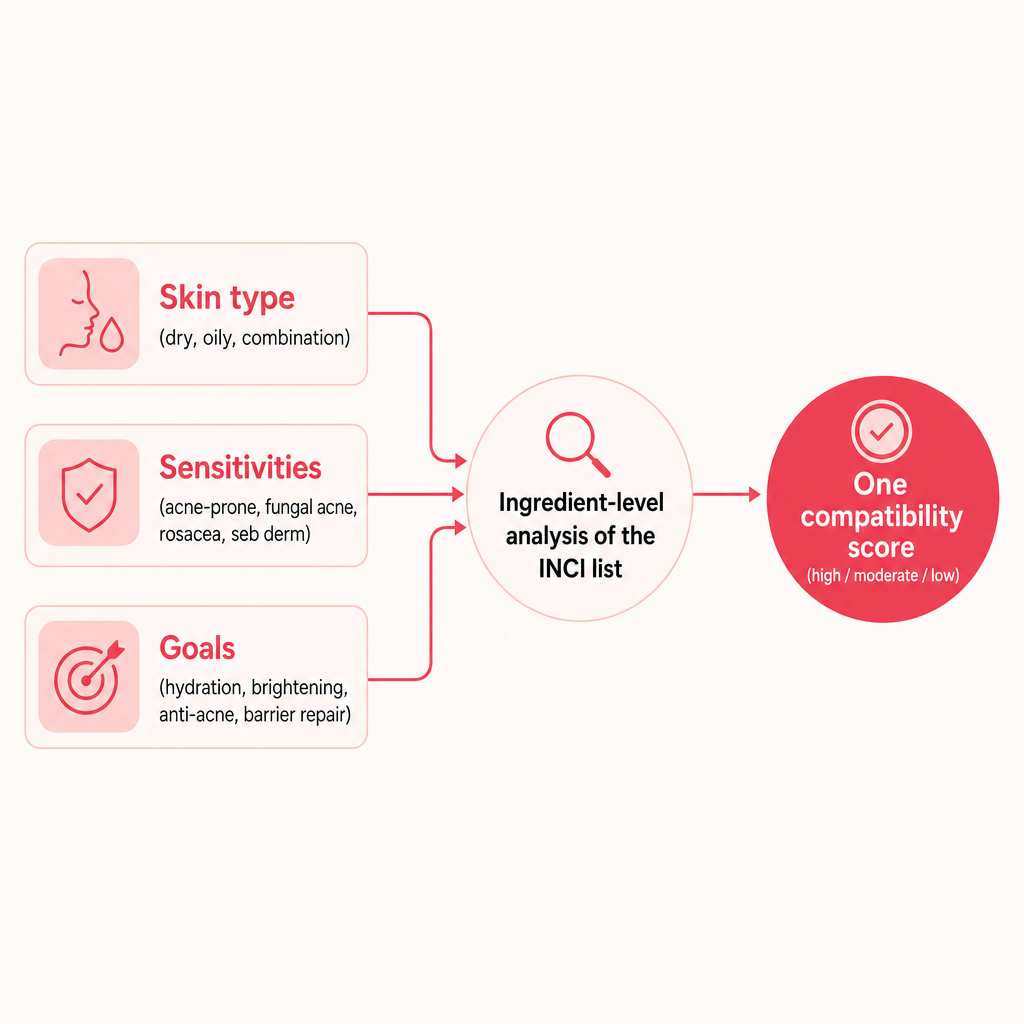
Before the number appears, three things about you shape it: your skin type (dry, oily, combination), your sensitivities (acne-prone, fungal acne, rosacea, seborrheic dermatitis, and more), and your goals (hydration, brightening, anti-acne, barrier repair). Once that profile exists, any product you scan or search gets evaluated against it. The result is meant to help you make a buy, keep, or avoid call without judging every ingredient yourself.
We also say this plainly: no ingredient-based tool can predict an individual reaction with certainty. The score is a structured, evidence-informed estimate that helps you make safer decisions, not a promise about how your skin will behave.
What actually goes into the number
Your profile is only the starting point. Behind every score sits an ingredient-level analysis of the product's INCI list. We pull the full list and translate it into plain-language benefit and risk context, then reconcile that against who you are.
That reconciliation weighs a few different things at once:
- Alignment. Does the formula contain ingredients and vehicles that support your main goals, such as proven hydrating agents for dry skin or soothing agents for sensitive skin?
- Conflicts. Does it contain known triggers for the conditions you track, such as Malassezia-feeding esters for fungal acne or highly comedogenic oils if you are acne-prone?
- Overall formula fit. Is the mix of actives, bases, and potential irritants likely to feel suitable for your skin type, like rich occlusives for very dry skin versus lighter gels for oily skin?
The output tries to summarize the net fit: how much the product appears to help your goals, minus how much it might conflict with your sensitivities. A formula packed with supportive ingredients but carrying one serious trigger for a condition you flagged will land very differently than the same formula would for someone who does not track that condition.
If you want to see this reasoning up close, our ingredient checker breaks a formula down function by function, and the cosmetic barcode scanner pulls the same analysis while you are standing in a store.
How we analyze ingredients behind the score
Understanding your skincare compatibility score gets much easier once you see what happens at the ingredient level. Rather than showing names and numbers, we decode each ingredient into what it does, why it is in the formula, and when it might cause trouble.
That decoding covers core functions (emollient, humectant, surfactant, preservative, fragrance, active), evidence-informed concerns (irritation potential, sensitization patterns, published comedogenic or Malassezia-related signals where available), and honest unknowns. Trade names or ambiguous botanicals that cannot be reliably matched to a single material get highlighted, so you know what could not be fully interpreted rather than assuming silence means safety.
Comedogenic and pore-clogging risk
For acne-prone skin, pore-clogging risk is a big slice of compatibility. Comedogenicity research typically uses a 0 to 5 scale, where 0 means no pore-clogging in test conditions and 4 to 5 means strong clogging potential when an ingredient is tested at high concentrations on animal models. Modern comedogenic checkers match each ingredient in the INCI list against curated tables of these ratings and flag the higher-end entries.
The important nuance: a raw ingredient tested neat is not the same as a tiny amount buried in a finished formula. Our pore-clogging analysis follows this logic, highlighting likely suspects without treating every flag as a guaranteed breakout. You can run any formula through our pore-clogging checker to see which ingredients raised a flag and why, and our explainer on how the pore-clogging checker works walks through the limits of those ratings in more depth.
Fungal acne and condition-specific risks
For fungal acne (Malassezia), we screen for ingredients known or strongly suspected to feed the yeast, using heuristics built from dermatology literature and ingredient chemistry. Each flagged ingredient is surfaced with a tiered risk label, so you can separate a mild concern from a high-risk material instead of lumping every worry together.
Condition-focused triggers for issues like seborrheic dermatitis and barrier sensitivity work the same way. We identify ingredients and patterns that literature and clinical practice associate with flares or irritation, then feed those risk signals into your overall score. If either condition is on your radar, the seborrheic dermatitis trigger checker surfaces the specific culprits a general score might smooth over.
Reading high, moderate, and low scores
A number is only useful if you know what to do with it. Here is how each band tends to translate into action.
| Score band | What it usually means | Sensible next move |
|---|---|---|
| High | Formula aligns closely with your type and goals, few or no strong triggers | Good fit, worth trying; patch test if you react easily |
| Moderate | Mixed signals: real support plus fragrance, essential oils, or borderline flags | Use with awareness; open the breakdown before deciding |
| Low | Several strong conflicts or few supportive ingredients for your goals | Proceed very cautiously or avoid; check why first |
A high score points to multiple supportive ingredients that match your goals, minimal or manageable conflict signals, and a formula style (light, rich, gel, cream, oil) that typically suits your skin type. It reads as "good fit, worth trying," while still respecting that patch-testing is wise if you have a history of strong reactions.
A moderate score usually reflects genuine tension. The product may work well on paper for your skin type but include fragrance, essential oils, or borderline comedogenic ingredients that are fine for many people yet questionable for you. Sometimes there is one flagged ingredient for a condition you track, but at a lower concentration or in a context that makes the risk uncertain. This is the "use with awareness" zone, and it is exactly where clicking into the ingredient breakdown pays off, because the score is not a simple yes or no.
A low score means that, relative to your profile, the formula carries several strong conflict signals or offers little support for your goals: multiple high-comedogenic ingredients for acne-prone skin, several Malassezia-feeding ingredients in a leave-on product for fungal acne, or harsh surfactants and drying alcohols in something pitched at dry or sensitive skin. It signals "proceed very cautiously or avoid," though you can still inspect the reasons to confirm they matter in your situation.
The score gets more powerful next to our other tools. Compare two products side by side to see how they differ in shared ingredients and unique actives, find a dupe with a similar profile but a potentially higher score for your skin, or build a routine where every product earns a reasonable score and formula clashes are surfaced before they reach your face.
What the score cannot do
Even with detailed analysis, the honest boundaries matter. No system can guarantee you will not react. Rare allergies, individual immune responses, and interactions with medications or treatments sit outside anything an ingredient list can prove.
Comedogenic and Malassezia risk ratings come from controlled studies on simplified setups, often animal models or in vitro work, which do not perfectly mirror real-world concentrations and product combinations. And a score is only as good as the data behind it: incomplete or inaccurate ingredient lists from brands or retailers can hide materials that would otherwise change the result. If the INCI is wrong, any analysis built on it is constrained.
So treat the number as a strong decision aid, not an infallible medical judgment. It helps stack the odds in your favor. Patch testing and paying attention to your own skin stay essential.
Two people, one product: a quick example
Picture an acne-prone user with fungal acne concerns opening a new moisturizer. We identify several hydrating agents that support barrier repair, but also flag multiple high-comedogenic oils and Malassezia-feeding esters. The resulting moderate-to-low score reflects a real trade-off: the helpful ingredients are outweighed by realistic breakout and flare risks for that specific profile.
Now hand the same product to a dry, non-acne-prone user with no fungal acne history. The pore-clogging flags barely register for this profile, while the occlusive and emollient ingredients are strongly supportive. Same formula, higher score, closer to a "this might be perfect for you" verdict. Nothing about the product changed; the profile reading it did.
Frequently asked questions
Is a higher compatibility score always "safe"?
Higher scores indicate better alignment with your profile and fewer strong red flags, but they cannot guarantee the absence of irritation or allergy. Treat the score as a probability-based guide, not a clinical guarantee.
Why did my friend get a different score for the same product?
Because the score is personalized. Two people with different skin types and sensitivities can look at the same formula while the system weighs its risks and benefits differently for each of them, producing different numbers.
Can the score change over time?
Yes. If you update your skin profile, for example by marking yourself fungal acne-prone or adding a new sensitivity, the way we interpret each ingredient's risks and benefits for you can shift, and the score updates with it.
Does the score replace patch testing or dermatology advice?
No. It is an evidence-informed tool built on ingredient data and published risk signals, but it does not replace patch testing or personalized guidance from a dermatologist, especially for complex or severe conditions.
What should I do when a product I love has a low score?
Open the ingredient breakdown to see why it scored low, then decide whether those reasons match your actual experience. Some people knowingly accept a specific risk, like a mild comedogenic flag, when a product performs exceptionally well for them, as long as they understand the trade-off.