
Pore-Clogging Ingredient Checker: How It Works
A pore clogging ingredient checker scans a product's ingredient list and flags the components most likely to block pores and feed breakouts like blackheads, whiteheads, and comedonal acne. That is the short answer, but the useful part is what happens after the flag: our pore-clogging ingredient checker rolls those signals into a single compatibility score and explains, in plain language, which ingredients matter for your skin specifically. Instead of scrolling through raw comedogenic numbers, you get a clear read on whether a moisturizer, sunscreen, or foundation is likely to cooperate with congestion-prone skin.
The decision this tool helps you make is deceptively simple: keep this product, patch-test it cautiously, or skip it. Getting that call right depends less on any single ingredient and more on how the whole formula behaves on your face. Below we break down what the checker actually evaluates, the science behind clogged pores, how the 0-5 comedogenic scale works, and when to trust the signal versus your own skin.
Table of contents
What a pore-clogging ingredient checker actually does
"Pore-clogging," or comedogenic, describes how likely an ingredient is to block a hair follicle opening and form a plug of oil and dead skin cells called a comedone. A checker takes the full ingredient list from a skincare or cosmetic product and evaluates each component for that comedogenic tendency, then reports back what it found.
Most modern checkers lean on comedogenic rating data that score ingredients from 0 (non-comedogenic) to 5 (highly comedogenic). Raw scores alone are not the whole story, so a good tool layers in practical context:
- Is the product leave-on or rinse-off? Leave-on formulas with high-rated ingredients carry more risk because they sit on skin longer.
- How acne-prone or congestion-prone is your skin? Ratings above 2 to 3 matter far more if you break out easily.
- Are several moderately comedogenic ingredients stacked in one product, where the risk can add up beyond any single component?
Our pore-clogging ingredient checker follows this logic but presents the result in a clean, readable way. Rather than leaving you to interpret individual numbers, it consolidates the signals into one compatibility score per product and shows which ingredients may contribute to clogged pores for your specific skin type and concerns.
Why ingredients clog pores, in plain language
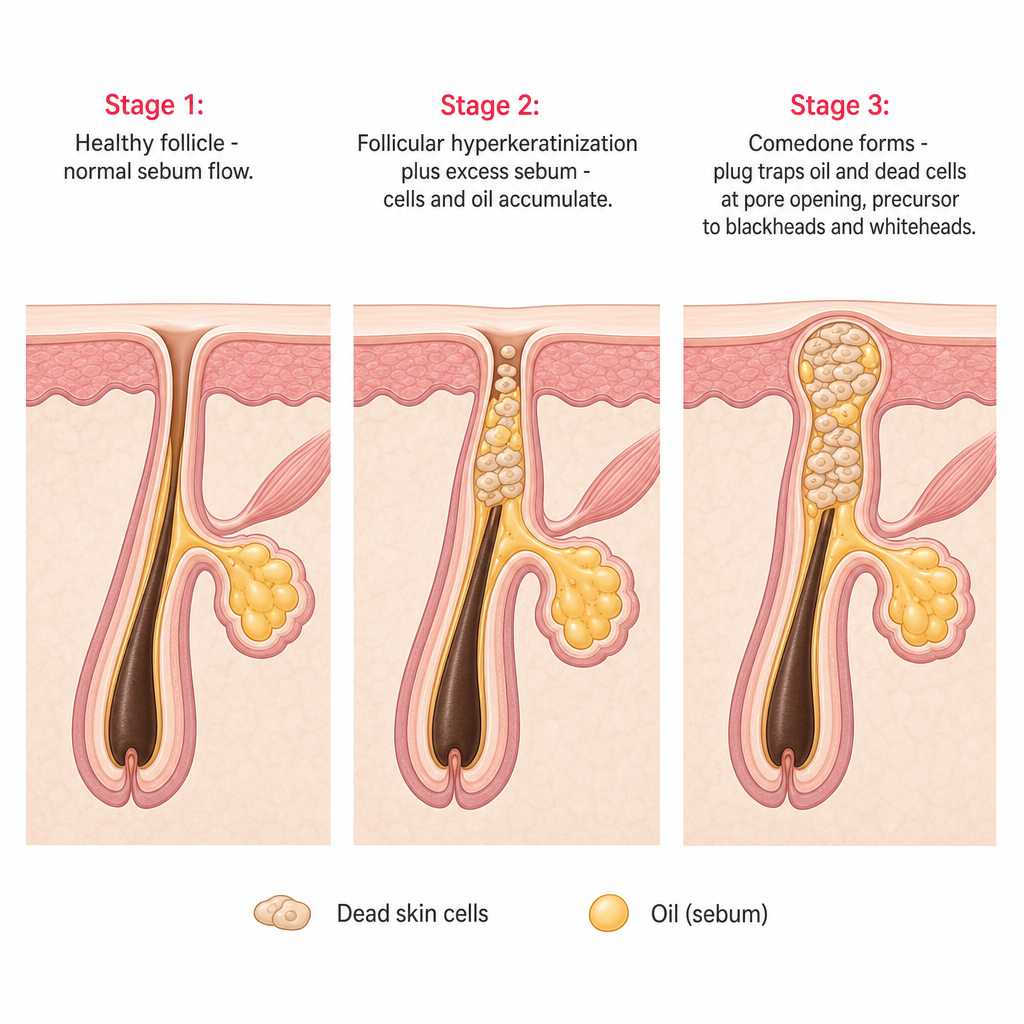
To see why this analysis matters, it helps to understand how a clogged pore forms in the first place.
Acne and congestion begin when the lining of the pore overproduces skin cells, a process called follicular hyperkeratinization, while the sebaceous glands push out excess sebum. Those extra cells mix with oil and get trapped inside the pore opening, forming a small plug. That plug is a comedone, the precursor to blackheads and whiteheads.
Certain cosmetic ingredients can nudge this process along in two main ways:
- By being very occlusive, forming a heavy film that traps oil and dead cells against the skin.
- By increasing follicular hyperkeratinization in test models, which is how the classic comedogenic ratings were originally measured.
Comedogenic scales were developed to quantify how strongly different substances promote these follicular blockages, typically using models where an ingredient was applied and the pores were later examined for plug formation. A pore-clogging ingredient checker translates that lab idea into a shopper's question: if I put this on my face regularly, how likely is it to contribute to clogged pores for me?
Inside the comedogenic scale
Most ingredient databases and references describe pore-clogging potential on a 0 to 5 comedogenic scale. The exact wording shifts between sources, but the core tiers are consistent.
| Rating | Meaning | Practical read for congestion-prone skin |
|---|---|---|
| 0 | Non-comedogenic | Not expected to clog pores for almost anyone |
| 1-2 | Low risk | Usually tolerated, though very sensitive users may still react |
| 3 | Moderate risk | Can clog acne-prone pores; often flagged "use with caution" |
| 4-5 | High to very high risk | Frequently linked to clogged pores and breakouts |
Dermatology writers and ingredient resources often treat 0 to 2 as the practical safe zone for congestion-prone users, while ratings from 3 to 5 deserve closer scrutiny in leave-on formulas like moisturizers, sunscreens, and makeup bases.
Our checker uses this kind of scale as the backbone of its analysis, then wraps it in a more understandable layer. Instead of showing you only raw numbers, it explains which ingredients land in higher-risk categories and how strongly they shape a product's overall pore-clogging profile. If you want to run a list through it yourself, our pore-clogging (comedogenic) checker does exactly that.
Why context beats a single number
A key limitation of comedogenic ratings is that they are not guarantees. Several expert and brand resources point out that the classic 0 to 5 scale carries assumptions and flaws worth knowing:
- Many ratings were derived from animal models, like rabbit ears, or narrow test conditions that do not fully match real human use.
- The same ingredient can behave differently depending on its concentration, the surrounding formulation, and whether the product is rinsed off or left on.
- Individual skin differences mean an ingredient rated 2 might break one person out while staying completely harmless for another.
Because of these limits, current guidance treats comedogenic ratings as directional signals rather than absolute rules. That is precisely where a checker earns its keep: it contextualizes risk instead of treating every 3 or 4 as automatically off-limits.
In our case, the checker looks at the mix of ingredients rather than any single component in isolation, weighs pore-clogging signals differently for different product types (a cleansing oil versus a thick overnight cream, for example), and fits those signals into your broader skin profile, including whether you are already flagged as congestion-prone. The output is a practical risk picture, not a rigid list of good and bad ingredients.
How our pore-clogging checker works for you
Macherre is built for people who want clarity on skincare without needing a chemistry background. The pore-clogging ingredient checker lives inside that ecosystem alongside tools for fungal acne screening, seborrheic dermatitis triggers, dupe finding, routine building, and ingredient decoding, all tied to one skin profile.
Here is what happens when you run a product:
- You scan a barcode or search the product, and we read the ingredient list, matching each component against our ingredient dictionary and risk data.
- Each ingredient is evaluated for comedogenic potential using rating data and occlusive behavior, mapped to the 0 to 5 style scales above.
- We factor in your skin type, sensitivities, and acne history, so a moderately comedogenic ingredient can be flagged more strongly if you are very breakout-prone.
- We generate a single compatibility score for the product, showing how well it is likely to sit with your skin overall, congestion included.
- You get a plain-language breakdown for every ingredient: what it does (emollient, surfactant, humectant, and so on), whether it is tied to pore-clogging, irritation, or fungal acne triggers, and why that matters for you.
Because we also run a dedicated fungal acne screen, we can recognize that fungal acne and comedonal acne often coexist and prompt congestion-prone users to check relevant products through both lenses. Someone with oily, acne-prone, and sensitive skin can then see when a product is fine for one issue but risky for another.
Our independence and privacy-first stance mean this analysis is not tied to specific brands or retailers. The read is ingredient-driven, so you can compare a mainstream product, a niche option, and a potential dupe on equal footing using the same congestion logic. If you want to weigh two options directly, our side-by-side product comparison uses that same scoring, and if you are curious about how the underlying analysis reads a full list, what a skincare ingredient checker really tells you goes deeper.
When to trust the signal versus your skin
A pore-clogging ingredient checker works best as one input in a wider decision, not the sole verdict. A few evidence-based criteria help you weigh it well.
Your baseline skin type and acne history. If you have a history of comedonal acne, frequent blackheads, or persistent congestion, you benefit most from avoiding products with several high-rated comedogenic ingredients. Dry skin that rarely breaks out can often tolerate the same ingredients, especially at low concentrations.
Product category and usage pattern. Ratings matter more for products that stay on the skin, like moisturizers, sunscreens, primers, and foundations, than for rinse-off or short-contact products such as cleansers and masks, because longer contact raises the odds of blockage. The checker helps you tell high-risk leave-on congestion apart from a lower-risk wash-off formula containing the same ingredient.
Concentration and layering. An ingredient rated 3 to 4 might pose modest risk in a light serum but more in a rich cream applied twice daily. Stacking several products that each carry moderately comedogenic ingredients can accumulate into real congestion, so running your whole routine through the checker surfaces patterns you would miss product by product. Our routine builder with clash detection makes those overlaps easier to catch.
Coexisting conditions. Fungal acne and comedonal acne can appear together, and some ingredients that are safe for pores still trigger Malassezia-related issues or seborrheic dermatitis flares. Our seborrheic dermatitis trigger checker complements the pore-clogging read so you see the full risk picture, not one slice of it.
Real-world feedback from your own skin. Even with good data, the strongest signal is how your skin actually responds. Comedogenic scales are guides, not guarantees, and the smart move is combining ratings with your own experience over time. Logging products and their compatibility scores, then linking them to how your skin behaved, turns a one-off scan into a track record you can act on.
Used this way, the checker keeps you clear of blanket ingredient fear while still protecting acne-prone and congestion-prone skin from the risks that are genuinely predictable.
Frequently asked questions
Do pore-clogging ingredient checkers replace dermatologist advice?
No. They translate ingredient-level evidence and comedogenic ratings into practical guidance, but they do not diagnose or treat medical conditions. Comedogenicity data comes from controlled tests and models that are informative but not a substitute for personalized medical assessment.
If an ingredient is rated 4 to 5, will it definitely break me out?
Not always. A 4 to 5 rating means an ingredient has a high tendency to clog pores in acne-prone skin, especially in leave-on products. Your individual tolerance, the formulation, and how often you use the product still shape the outcome.
Are products with only 0 to 2 rated ingredients always safe?
Ingredients rated 0 to 2 are generally considered non-comedogenic or low risk for most people. Even so, other factors like irritation, occlusion from a heavy texture, or unrelated triggers can still cause problems, which is why we screen for irritancy and other issues alongside pore-clogging signals.
Can a pore-clogging checker help with body acne on the back and chest?
Yes. Comedones form in follicles across the body, so the same pore-clogging ingredients can drive breakouts on the back and chest. Leave-on body lotions, sunscreens, and hair products that touch the skin can be assessed the same way, and the checker helps you spot high-risk ingredients in those too.
How is Macherre different from a single-purpose comedogenic checker?
Single-purpose tools usually stop at showing a 0 to 5 rating per ingredient. We fold pore-clogging signals into one overall compatibility score per product, connect it to your skin profile, and pair it with tools like the fungal acne and seborrheic dermatitis checkers, so decisions happen in the full context of your skin rather than around a single number.