The Skincare Ingredient Checker That Decodes Any Product in Seconds
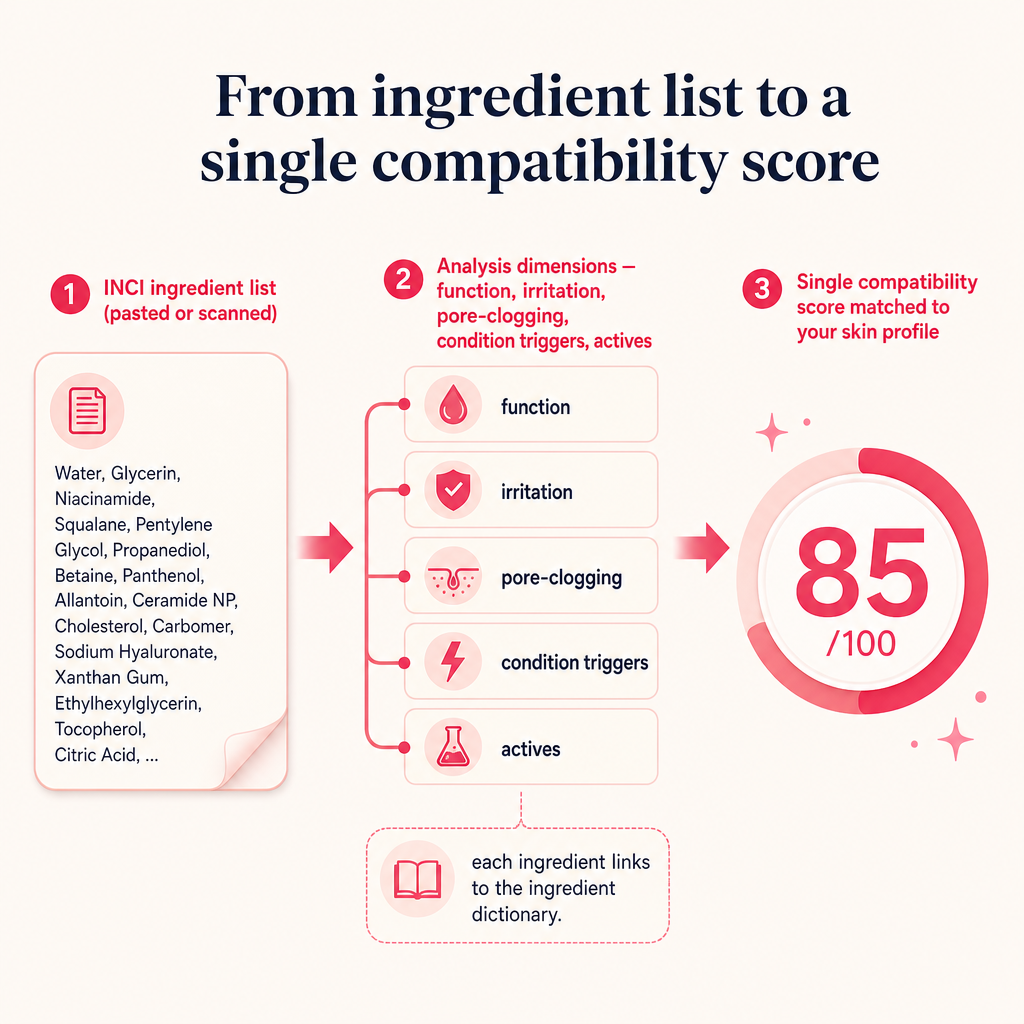
A skincare ingredient checker takes any product's full ingredient list and translates it into something you can actually act on: a plain-language breakdown of what each component does, which ingredients might irritate or clog, and how the formula suits your specific skin. Our ingredient checker skincare tool does exactly this, turning a wall of Latin and chemistry into a single compatibility score matched to your skin type, sensitivities, and goals — no chemistry background required.
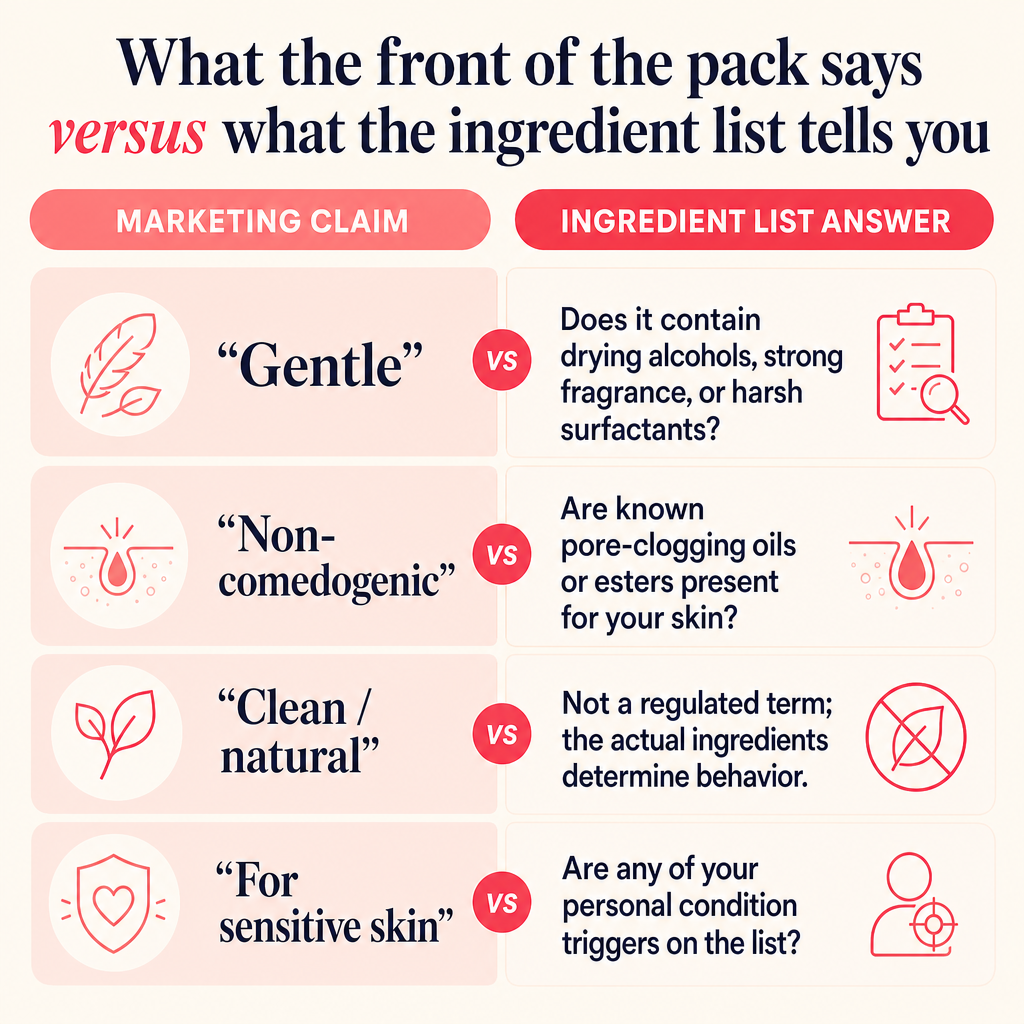
That gap between what a label promises and what a formula actually does is where most product regret happens. A jar can say "gentle," "clean," or "non-comedogenic" and still contain something that flares your skin. The ingredient list is the part you can trust, and it's the part we built everything around.
Table of contents
- What a skincare ingredient checker is, and how ours works
- The kinds of analysis, and our specialized checkers
- Why ingredient checking matters for your skin
- What to look for in an ingredient checker
- Your next step with your own products
- Frequently asked questions
What a skincare ingredient checker is, and how ours works
At its simplest, an ingredient checker is a tool that reads a product's INCI list — the standardized international names printed on cosmetic packaging — and produces a report on what's inside. Most tools work the same way at the entry point: you copy and paste an ingredient list from a product page, and the analyzer assesses the role and profile of each entry. Some let you paste lists across skincare, makeup, and hair care to compare formulas before you commit.
Where we go further is what happens after the parsing. Instead of handing you a flat list of green and red labels to interpret on your own, we fold every ingredient into a single product compatibility score built around your profile: your skin type, any conditions you've told us about, and what you're trying to achieve. One number answers the question you actually have — is this product likely to work for me?
Underneath that score, every ingredient gets a plain-language breakdown. You see its function first: whether it's a preservative, a solvent, an emollient, a humectant, or an active doing the heavy lifting. Then you see whether it carries a concern for your skin — irritation potential, pore-clogging risk, or a fungal-acne association — flagged clearly rather than buried. Each entry links back into our in-depth ingredient dictionary, so if you want to understand why something is flagged, the deeper explanation is one tap away instead of a search-engine rabbit hole.
The design principle is that the score does the summarizing and the breakdown does the teaching. You can act on the number in seconds in a store aisle, or you can read the reasoning when you have time to learn what your skin responds to. That two-layer design is deliberate: a beginner can trust the single figure without decoding a single INCI name, while a more experienced user can drill into each flag, weigh concentration and product type, and decide how much a given concern really matters for their own routine. Neither user is forced into the other's workflow, and both are working from the same underlying analysis rather than two different tools.
The kinds of analysis, and our specialized checkers
Modern ingredient analysis isn't one check — it's several distinct lenses looking at the same list. The dimensions most checkers surface are fairly consistent: comedogenic ingredients, irritants, and allergens are the standard flags, and good tools also help you see past marketing language to what a formula actually contains. We organize that work into a few clear categories, each with a dedicated way in.
Comedogenicity, or pore-clogging risk. Some oils, fatty acids, and esters are commonly associated with breakouts in acne-prone skin. Our pore-clogging ingredient checker scans a list specifically for these and marks them, so you can spot what might be behind a stubborn cluster of bumps. It's the same underlying intelligence as the main checker, tuned to answer one focused question, and it maps the flagged ingredients back to your skin type so a component that only troubles very oily, congestion-prone skin isn't treated as a universal villain.
Condition triggers. Reactive skin often reacts to patterns, not single villains. Certain surfactants, fragrances, and known irritants show up again and again in flare-ups. Our seborrheic dermatitis trigger checker looks for the ingredients tied to that condition specifically, and our main checker can flag ingredients commonly linked to fungal-acne issues as part of its analysis. This is where personalization matters most: an ingredient that's fine for one person can be a repeat offender for another, and only a system that knows your conditions can tell those two cases apart.
Irritation and allergen exposure. Beyond named conditions, we flag broadly irritating components — drying alcohols, strong fragrance, harsh cleansing agents — so sensitive-skin users can vet a product before it ever touches their face. These flags are the ones that catch the low-grade, hard-to-trace reactions that don't announce themselves as an obvious rash.
Actives versus support. Not every notable ingredient is a risk. The checker distinguishes the actives doing real work — the retinoids, acids, and vitamin derivatives — from the soothing agents, occlusives, and stabilizers around them. Our ingredient-by-ingredient breakdowns separate the hero from the supporting cast so you understand what you're actually buying, and so you don't mistake a gentle stabilizer for the ingredient responsible for a formula's results.
There's also more than one way to feed a list in. If you're standing in a shop and don't want to type, our cosmetic barcode scanner pulls the product, retrieves its ingredients, and runs the same analysis and scoring — the fast path for an in-store decision. The intelligence is identical; only the entry point changes.
Why ingredient checking matters for your skin
The honest reason ingredient checking matters is that the front of the pack is the least reliable part of the label. Terms like "natural," "clean," and "non-toxic" are not tightly regulated, which means a brand can use them without meeting any uniform standard. The ingredient list, by contrast, is the regulated, standardized part — which is exactly why every serious checker is built on it. When you learn to read the list, you stop buying claims and start buying formulas.
What that shift looks like depends on who you are.
If you're new to skincare, the barrier has never been effort — it's translation. You don't lack the will to check a label; you lack the chemistry to decode it. Plain-language breakdowns remove that barrier entirely. Instead of memorizing which alcohol is drying and which is a fatty emollient, you see the function and the flag spelled out, and the single score tells you whether the details add up in your favor.
If you have sensitive or reactive skin — rosacea, eczema, seborrheic dermatitis, fungal acne — the value is pattern detection. A single product might look fine, but the same trigger repeating across your cleanser, moisturizer, and sunscreen can keep you in a low-grade flare you can't explain. Condition-specific flags catch that repetition across your whole shelf, not just one product at a time, which is where isolated single-product checks tend to miss the real cause.
If you're shopping on a budget, ingredient intelligence turns into buying power. When you can see that a pricey product and an accessible one share the meaningful parts of their formula, you can trade down without trading results. Our dupe finder is built on exactly this logic — ingredient overlap and functional similarity — so value shopping stops being guesswork.
If you're an enthusiast optimizing a multi-step routine, the risk isn't a single bad product; it's how good products interact. Layering too many strong actives, doubling up on the same function, or stacking irritants across steps can undo the work. Ingredient analysis is what makes those clashes visible before your skin flags them for you.
What to look for in an ingredient checker
Not every tool that reads a label does the same job, so it helps to know what separates a raw analyzer from something you can actually decide with. These are the criteria worth weighing.
Personalization over generic scores. Many checkers are essentially raw analyzers: they list what an ingredient is and offer a broad safety note, then leave the interpretation to you. That's useful, but it treats every user identically. A far more useful question is whether the tool maps ingredients to your conditions and goals and produces a score that reflects them. A formula that scores well for oily, acne-prone skin may score very differently for someone managing seborrheic dermatitis — and only a personalized system captures that.
Independence. An ingredient verdict is only worth as much as its neutrality. We're fully independent and privacy-first, with analysis that isn't shaped by brand sponsorships, so a flag means what it says. When you're deciding whether to trust a product, you want the checker working for your skin, not for a marketing budget.
Condition-specific depth. General irritation flags are table stakes. The differentiator is whether a tool goes deeper for the situations that actually keep people up at night — pore-clogging, fungal acne, seborrheic dermatitis triggers — with checks tuned to each rather than one blunt "good or bad" label.
Honest context, not fear. The best evidence is clear that ingredient risk is contextual: concentration, product type, and personal sensitivity all matter, and oversimplified "toxic" scores can mislead. A hazard flag reflects potential risk, not a guaranteed outcome. A checker worth using treats its score as a personalized signal to reason with, not a moral verdict on the product — which is precisely why ours is framed as compatibility with your skin rather than an absolute grade.
Routine and value integration. Single-product vetting is only half the picture. The stronger tools let you carry ingredient insight into how you actually shop and build. That means clash detection when you assemble a routine, side-by-side comparison when you're torn between two products, and dupe matching when price is the deciding factor. Intelligence that stays trapped in one-off checks leaves most of its usefulness on the table.
Measured against those criteria, the point isn't that one tool wins on a scoreboard — it's that you should expect personalization, independence, condition-specific depth, honest framing, and integration to work together. When they do, ingredient checking stops being a chore and becomes the quiet backbone of every product decision you make.
Your next step with your own products
The most useful thing you can do next is stop reading about ingredient analysis and run your own shelf through it. Paste in the products already sitting on your bathroom counter, or scan them, and see which ones actually earn their place for your skin. The scores will tell you fast where the surprises are, and the plain-language breakdown underneath each one shows you exactly which ingredient is responsible for a low score rather than leaving you guessing.
From there, the natural moves depend on what you find. If two products keep competing for the same slot, put them head to head with our side-by-side product comparison. If you're assembling or reworking a full lineup, our routine creator with clash detection catches the layering conflicts before your skin does. And if a favorite is more than you want to spend, the dupe finder points you to formulas that do the same work for less. The checker is the starting point; the rest of the toolkit is what turns a single insight into a routine that fits.
Frequently asked questions
What does a skincare ingredient checker actually analyze?
It reads a product's INCI list and assesses each ingredient — its function and its concerns. Standard checkers generate a report from a pasted list and flag comedogenic ingredients, irritants, and allergens. Ours adds function labels (preservative, emollient, active) plus condition-specific flags and rolls it all into one compatibility score for your profile, so you get both the individual detail and a single answer for your skin.
Is a single compatibility score enough to judge a product?
The score is a strong shortcut, not the whole story. Ingredient risk is contextual — concentration, product type, and your own sensitivity all matter — and any flag reflects potential risk rather than a guaranteed reaction. That's why our score is framed as compatibility with your skin, with a full plain-language breakdown underneath so you can see the reasoning, not just the number, and decide how much a given concern weighs for you.
Can an ingredient checker replace a dermatologist?
No. A checker surfaces risk flags, not medical diagnoses. It's excellent for vetting products, spotting repeating irritants, and understanding formulas — but for a diagnosed skin condition, persistent reactions, or treatment decisions, a qualified professional is the right call. Think of ingredient analysis as informed product decisions, not clinical care.
How is Macherre different from other ingredient checkers?
We're fully independent and privacy-first, with no brand sponsorships shaping the analysis. Rather than leaving you to interpret a raw list, we produce a single compatibility score tied to your skin type and conditions, write every breakdown in plain language for beginners, and run specialized checks for pore-clogging, fungal acne, and seborrheic dermatitis triggers off the same intelligence.
Do I need to know INCI names to use it?
Not at all. You can paste a full ingredient list straight from a product page, and the tool handles the parsing. If typing isn't practical — say you're in a store — our cosmetic barcode scanner pulls the product and its ingredients for you and runs the same analysis. The whole point is that no chemistry knowledge is required on your end.
Can it help me find cheaper alternatives with similar ingredients?
Yes. Our dupe finder uses the same ingredient database and matching logic to locate products with similar formulations at different price points or availability. It compares ingredient overlap and functional similarity, so you can trade down on cost while keeping the parts of the formula that actually do the work for your skin.