Best Products for Fungal Acne, Ranked by Ingredients
Fungal acne doesn't care about a product's marketing. It cares about lipids. The bumps that show up in uniform little clusters on your forehead, chest, and back are driven by Malassezia yeast, and that yeast feeds on very specific ingredients: certain fatty acids, plant oils, esters, polysorbates, and fatty alcohols. So the search for the best products for fungal acne isn't really about brands at all. It's about reading what's inside the bottle and choosing formulas that starve the yeast instead of feeding it.
That's the lens for this whole list. Instead of ranking specific bottles, we rank product types by how well their ingredients do four things: avoid feeding Malassezia, hydrate and calm with yeast-safe actives, add antifungal support when a flare needs it, and stay gentle enough for sensitive, multi-condition skin. Then we show exactly how to use Macherre to pressure-test any real product you're eyeing against those criteria, find a cheaper dupe, and slot it into a routine without clashes.
Table of contents
How we picked the best products for fungal acne
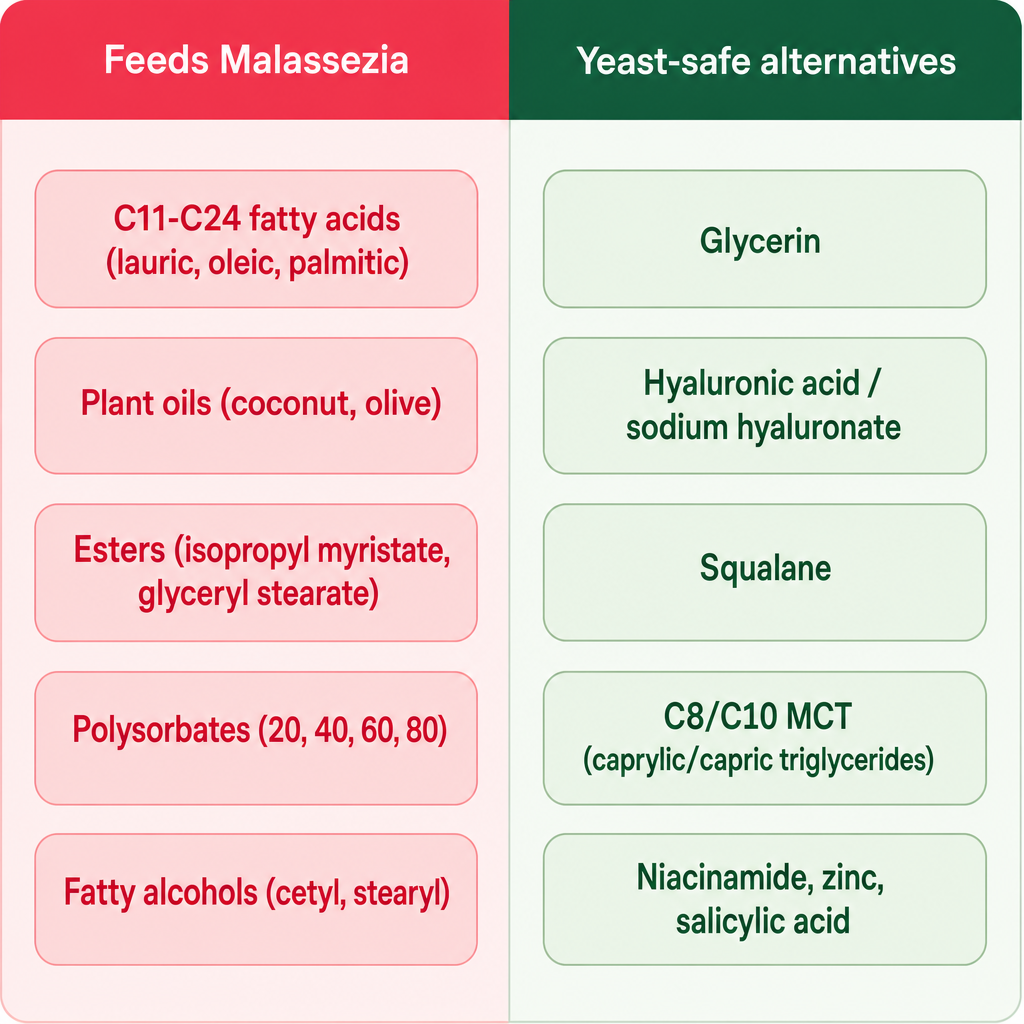
Every pick below earns its place on ingredient logic, not on a label promise. Malassezia thrives on certain oils, fatty acids, esters, polysorbates, and fatty alcohols, especially in roughly the C11 to C24 carbon range. That means coconut, olive, and many plant oils, esters like isopropyl myristate, polysorbates, and fatty alcohols such as cetyl or stearyl alcohol can all act as food. A product that leans on those ingredients can quietly keep a flare going no matter how gentle it feels.
The formulas that behave better do the opposite. They hydrate with humectants and non-lipid actives that the yeast simply can't metabolize: glycerin, hyaluronic acid, sodium hyaluronate, panthenol, and urea for moisture, plus niacinamide, zinc, salicylic acid, and azelaic acid to calm inflammation and keep follicles clear. When a flare is active, dermatology guidance points to antifungal actives such as ketoconazole, selenium sulfide, and zinc pyrithione, often delivered through a wash or shampoo used as a short-contact mask.
The last criterion is real-life fit. Many people with fungal acne also live with seborrheic dermatitis, eczema, or rosacea, so the strongest routines favor gentle, sulfate-free cleansing, non-stripping textures, and emollients like squalane, mineral oil, or C8/C10 MCT oil without lauric acid. Macherre's job across all of this is practical: decode the ingredient list, flag fungal acne triggers, check pore-clogging and seborrheic dermatitis risk, and help you compare options and find dupes so the routine fits your skin and your budget.
Leave-on antifungal treatment (ketoconazole or zinc pyrithione)
When a flare is genuinely active, nothing on this list works faster than a direct antifungal. Dermatology guidance routinely points to ketoconazole (the active in Nizoral-style shampoos), selenium sulfide, and zinc pyrithione to reduce Malassezia yeast in fungal acne and seborrheic dermatitis. Used as a short-contact mask on affected areas, roughly five to ten minutes before rinsing, these can calm an angry patch of uniform bumps quickly.
This category earns the top spot because it's the only one that treats the underlying overgrowth rather than working around it. It's the right call for confirmed or strongly suspected Malassezia folliculitis on the face, chest, back, or scalp, and for oily, sweaty areas that keep breaking out despite a standard "acne" routine. It suits people who can tolerate a medicated wash a few times a week without ending up painfully dry.
Here's where ingredient decoding matters even for a medicated product. Scan the wash with the cosmetic barcode scanner for ingredient clarity to get a plain-language breakdown of the antifungal active, then run the full formula through the fungal acne checker to make sure the base isn't hiding problematic esters, polysorbates, or heavy plant oils. Adding it to your routine lets clash detection flag it against your other actives.
The limitation is real: antifungal washes can be drying, especially when overused or stacked with strong exfoliants. They also don't fix pore congestion, barrier damage, or bacterial acne, so most routines still need a gentle hydrator and, where appropriate, a BHA or AHA. Follow local medical guidance and patch test if your skin is reactive.
Gel cleanser without oils, esters, or polysorbates
A cleanser touches your skin every single day, so a wrong one quietly sabotages everything else. For fungal acne-prone skin, the ideal daily cleanser is a simple, sulfate-free gel with gentle surfactants like decyl glucoside and no plant oils, fatty acids, esters, polysorbates, or waxy emulsifiers that can feed yeast. It clears sweat, sunscreen, and surface buildup without leaving behind a film the yeast can eat.
This is the pick for oily or combination skin that develops tiny, uniform bumps and clogs after sunscreen or makeup, and it's especially valuable in hot, humid climates where sweat and occlusion make flares worse. It also serves sensitive, multi-condition skin that reacts badly to fragrance-heavy or stripping foaming cleansers.
Where Macherre pays off is in spotting the sneaky offenders. Use the skincare ingredient checker that decodes any product to catch red-flag families that marketing hides: C11 to C24 fatty acids like lauric and oleic, esters such as isopropyl palmitate, the polysorbate range, and fatty alcohols. Run the same cleanser through the pore-clogging (comedogenic) checker so you don't trade a fungal trigger for a comedogenic one, then save it to a shelf and compare it against alternatives.
The trade-off: a very lean gel can feel too light for dry or mature skin, particularly in cold weather or alongside eczema. Some people also need a separate oil-free makeup remover or micellar water to fully dissolve heavy sunscreen or long-wear foundation without rubbing.
Humectant-only hydrating serum
Hydration is where most fungal acne routines accidentally go wrong, because "moisture" and "oil" get treated as the same thing. A humectant-focused serum built on glycerin, hyaluronic acid or sodium hyaluronate, panthenol, and urea hydrates by pulling in and holding water rather than depositing lipids, which keeps it entirely outside Malassezia's food supply. Urea and niacinamide add mild barrier and anti-inflammatory support, which quietly improves how well your skin tolerates antifungal treatment.
This serum type is ideal for dehydrated, tight-feeling skin that still breaks out under richer creams, and for sensitive or rosacea-prone users who can't handle strong actives but badly need barrier support. It's also the budget hero: one well-chosen workhorse serum can cover daily hydration, barrier care, and redness reduction at once.
Inside Macherre, decode the full list to confirm the humectants sit high in the ingredient order and that there are no hidden C11 to C24 fatty acids or esters lurking near the bottom. Drop it into the routine builder with clash detection to place it between your antifungal wash and moisturizer so the overall routine stays compatible. If the serum is pricey, run it through the skincare dupe finder to locate a near-identical humectant profile for less.
One caveat worth respecting: humectants draw water from the environment and from deeper skin layers, so in very dry or cold climates they perform best when lightly sealed with a fungal acne-safe moisturizer like squalane. You may still need separate actives such as azelaic acid or a BHA for oil control or pigmentation, layered carefully to avoid over-irritation.
Squalane- or C8/C10 MCT-based moisturizer
Sealing in that hydration is the step people fear most, because so many moisturizers are built on yeast food. Squalane sidesteps the problem entirely: it's a stable hydrocarbon with no fatty acid backbone, so Malassezia can't metabolize it. MCT oils limited to C8/C10 (caprylic/capric triglycerides), without lauric acid, offer similarly light moisturization without feeding the yeast, and mineral oil and dimethicone show up repeatedly as safe occlusives when used sensibly.
This category shines for normal-to-dry, fungal acne-prone skin that feels stripped or flaky after treatment washes, and for people with seborrheic dermatitis who need both antifungal control and barrier support. It's also the natural finish for a minimalist routine, one simple non-fragranced hydrator layered over a humectant serum.
Use the ingredient checker to confirm that squalane (spelled with an a, not squalene) or caprylic/capric triglycerides are the main emollients, and that no coconut, olive, argan, or other high-oleic oils sneak in. The seborrheic dermatitis trigger checker tells you whether the same product also suits overlapping scalp or facial derm issues. If a cream you love carries a few suspect esters or fatty alcohols, the dupe finder can surface a simpler alternative with similar texture but fewer triggers.
The limits cut both ways. A very simple squalane-only product can feel too occlusive if you overapply it on oily skin or in heat. Ultra-light formulas, meanwhile, may not be enough for serious barrier damage, eczema, or retinoid use, where you'll want additional Malassezia-safe barrier ingredients like ceramides or beta-glucan.
Mineral sunscreen built on zinc oxide
Sunscreen is non-negotiable, and it's also where fungal acne routines most often collapse. Mineral sunscreens that use zinc oxide, sometimes with titanium dioxide, in an oil-minimal, ester-light base are consistently the safer choice for fungal acne-prone skin. Zinc has a bonus: it can support oil regulation and offers mild antimicrobial activity, which is genuinely useful in an acne-prone routine.
Reach for this type when you need daily protection in humid climates where chemical filters plus occlusive bases trigger breakouts, when you're already managing fungal acne and seborrheic dermatitis around the hairline or forehead, or when your skin reacts to fragrance, alcohol-heavy, or strongly chemical-filtered sunscreens.
Scan any sunscreen to check whether zinc oxide is the primary UV filter and whether the base carries fungal triggers like polysorbates, heavy plant oils, or C11 to C24 fatty acid esters. Run it through the pore-clogging checker, because plenty of products labeled "non-comedogenic" still lean on ingredients with high comedogenic potential. When you're stuck between two candidates, compare two skincare products side by side to weigh white cast against texture against trigger count.
The honest downsides: mineral formulas can leave a visible white cast, especially on deeper skin tones, and may feel heavy on very oily skin. Some add esters or oils to spread more easily, so ingredient vetting stays essential, and patch testing matters even more when you're juggling fungal acne alongside rosacea or eczema.
Gentle exfoliant: salicylic acid or mandelic acid
Exfoliation is the optional step, but for the right skin it's the difference between smooth and perpetually bumpy. Salicylic acid, a BHA, penetrates into pores to dissolve sebum and debris, which helps prevent the follicular blockage that worsens both fungal and bacterial acne. Mandelic acid, a larger AHA molecule, tends to be gentler and more tolerable for fungal acne-prone skin, especially when it sits in a yeast-safe base.
This suits congested, bumpy skin where tiny clogs persist even after antifungal treatment, and oily or combination types who tolerate mild chemical exfoliation but react to physical scrubs. It's also useful when you're chasing both breakouts and post-inflammatory marks, since mandelic acid and niacinamide can improve tone and texture together.
Decode any exfoliant serum to confirm the acid is present at a sensible level and the base is free of high-risk oils, esters, and polysorbates. Then lean on the routine builder to cap how often you exfoliate and to avoid stacking it with too many other irritants like retinoids or strong acids. If the serum is expensive or hard to find where you live, a dupe search can surface a comparable profile at a different price.
The risk here is overdoing it. Over-exfoliation damages the barrier and can inflame both fungal acne and other conditions. Very sensitive, dermatitis-prone, or already-compromised skin is often better off skipping exfoliants entirely until the barrier recovers, focusing first on humectants, squalane, and antifungal support.
How to choose the right products for your fungal acne
The six types above aren't a shopping list to buy all at once. They're a toolkit you match to your own pattern. Start by naming your main problem, then build the smallest routine that addresses it.
| Your skin pattern | Lead with | Then layer |
|---|---|---|
| Uniform, itchy bumps on oily areas | Antifungal wash | Gel cleanser + zinc sunscreen |
| Mixed whiteheads/blackheads with fungal clusters | Antifungal support | BHA or mandelic acid + pore-clogging checks |
| Dry, reactive skin flaring after rich creams | Humectant serum | Squalane/MCT moisturizer, minimal actives |
From there, a minimal ingredient-driven order works for almost everyone: a gel cleanser with no oils, esters, or polysorbates; an antifungal wash two to three times a week and a gentle exfoliant only if your skin tolerates it; a humectant serum for hydration; a squalane or C8/C10 MCT moisturizer, optionally with ceramides and beta-glucan; and a zinc oxide mineral sunscreen every morning.
Climate shifts the emphasis. Hot, humid weather favors gel textures and lighter squalane or MCT moisturizers, and rewards you for being strict about oils and occlusives. Cold, dry weather calls for pairing humectants with slightly richer but still yeast-safe emollients while watching for barrier damage. And because ingredient labels differ by region, scanning a product translates whatever's on the box into standardized INCI names and clear safety flags, which is what makes a global routine possible in the first place.
Run every real candidate through the app before you commit. Decode the list to turn cryptic INCI names into plain language and flag known triggers, check the pore-clogging and seborrheic dermatitis scores so you don't fix one problem while creating another, and use side-by-side comparison and the dupe finder to swap costly or hard-to-source products for local formulas that hit the same profile.
Frequently asked questions
How do I know if a product is truly fungal acne-safe?
A formula is generally considered fungal acne-safe when it avoids Malassezia's main food sources, including C11 to C24 fatty acids, many plant oils, esters, polysorbates, and fatty alcohols, and instead relies on ingredients the yeast can't digest. Glycerin, hyaluronic acid, urea, panthenol, niacinamide, squalane, mineral oil, C8/C10 MCT oil, zinc, salicylic acid, azelaic acid, and kaolin clay are repeatedly cited as safer building blocks. Checking the ingredient list is far more reliable than trusting the front of the package.
Is "oil-free" always safe for fungal acne?
No. Plenty of "oil-free" products still use esters, polysorbates, and fatty alcohols that behave like oils from Malassezia's point of view. That's exactly why ingredient-level checking beats marketing language.
Can I treat fungal acne with a standard acne routine?
Often not. Traditional acne routines heavy in occlusive creams, rich plant oils, or certain AHAs can worsen fungal acne even when they help bacterial acne. Effective care leans on antifungal actives, yeast-safe hydrators, and careful avoidance of specific lipids and emulsifiers.
What if I also have seborrheic dermatitis, eczema, or rosacea?
These overlaps are common, and care usually means balancing antifungal control with barrier repair and sensitivity management. Gentle, sulfate-free cleansing, humectant-focused hydration, and safe emollients like squalane or C8/C10 MCT are typically preferred over aggressive multi-acid routines.
How does Macherre help if products in my country are different?
Because the analysis works on ingredients rather than brand hype, it adapts to any market where INCI lists and barcodes are available. You can scan, decode, compare, and find dupes for locally available products while keeping fungal acne, pore-clogging, and seborrheic dermatitis risk in view, with no chemistry background needed.